
**Ratchaburi’s Crystal Plains: Forging Diamond Salt with Saltfield Artisans Under the Midday Sun Mirage**
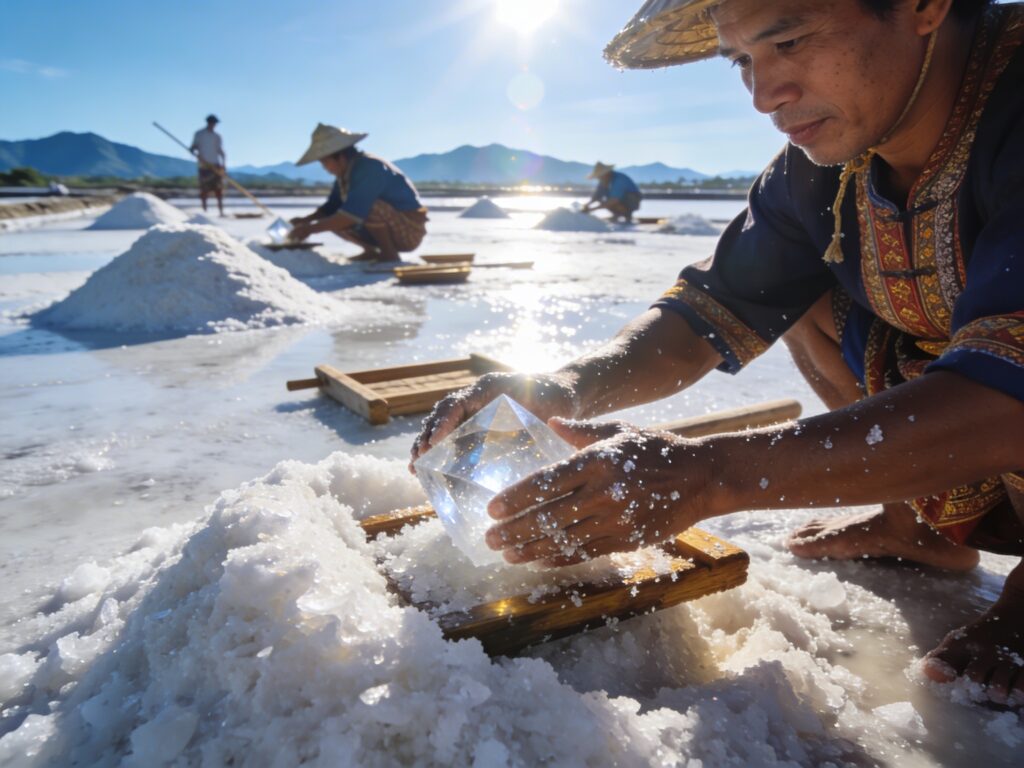
The Alchemy of Earth and Sky
Beyond the bustling markets and cave networks of Ratchaburi lies a landscape that seems plucked from a dream, or perhaps a mirage. Here, under the intense glare of the Thai sun, stretches the ethereal **Crystal Plains** – vast salt fields where seawater undergoes a magical transformation into glistening pyramids known locally as **Diamond Salt**. This isn’t just agriculture; it’s an ancient art form practiced by generations of saltfield artisans, a testament to patience and harmony with the elements.
From Gulf Waters to Glittering Pyramids: The Saltfield Process
The creation of Ratchaburi’s famed salt is a meticulous dance dictated by the dry season (roughly November to May) and generations of accumulated wisdom. It begins with the careful channeling of mineral-rich seawater from the nearby Gulf of Thailand into a series of expansive, shallow evaporation ponds:
The Gradual Concentration
Sun and wind work tirelessly. Over several days, water slowly evaporates in initial ponds, concentrating the brine and allowing impurities to settle. This concentrated brine is then carefully transferred to successive ponds, each stage increasing the salinity.
The Crystallization Canvas
The final stage occurs in the pristine **crystallization ponds**. Here, the supersaturated brine rests under the relentless sun. This is where the magic becomes visible. Salt crystals begin to form, not as flat flakes, but as distinct, inverted pyramid shapes – the hallmark of premium “Diamond Salt.”
The Midday Harvest
When the conditions are perfect – typically under the hottest, brightest midday sun ensuring maximum dryness – the saltfield artisans move in. Timing is crucial. Using traditional wooden tools, they skillfully rake the crystallized salt. The raking technique itself is an art:
- Gentle Gathering: Long-handled wooden rakes (mai krab) are used to gently gather the delicate crystals without breaking them.
- Forming the Mounds: The raked salt is carefully piled into long, gleaming white ridges or conical mounds (hua khao), resembling miniature mountain ranges scattered across the field.
- Drainage: These mounds allow any residual brine to drain away, leaving behind pure, dry salt crystals.
Artisans of the Salt: Masters of Sun and Sea
The true soul of the Crystal Plains lies with the salt farmers. Their knowledge is deep and hard-earned:
- Reading the Elements: They possess an intimate understanding of weather patterns, wind direction, and tidal influences, knowing precisely when to open sluice gates, transfer brine, or harvest.
- Feeling the Crystals: Experience tells them the exact moment the salt has reached its perfect crystalline structure and dryness by sight and touch.
- Generational Wisdom: Techniques are often passed down through families, preserving a way of life intrinsically linked to this unique environment.
Watching them work, bent under the shimmering heat haze (the midday sun mirage), moving with rhythmic efficiency across the blinding white expanse, is witnessing a profound connection between human labor and natural forces.
Experiencing the Crystal Plains
Visiting Ratchaburi’s salt fields is a sensory experience unlike any other:
- Visual Spectacle: The geometric patterns of the ponds, the blinding white of the drying salt, and the sparkling pyramids create an almost surreal, minimalist landscape, especially under the intense midday sun where heat mirages dance on the horizon.
- Photographer’s Paradise: Sunrise and sunset bathe the plains in golden and pink hues, while midday offers stark, high-contrast scenes. The symmetry of the ponds and the texture of the salt mounds are endlessly captivating.
- Taste the Difference: Many local vendors sell the freshly harvested salt. Taste a crystal – its clean, mineral flavor is a revelation compared to regular table salt.
- Respectful Observation: Remember this is a workplace. Stick to designated paths or viewing areas, avoid stepping on the delicate crystallization beds, and always ask permission before photographing workers up close.
A Legacy Forged in Salt
Ratchaburi’s Crystal Plains are more than just a source of salt; they are a living cultural landscape. They represent a sustainable, traditional industry where human skill harnesses the fundamental forces of sun and sea. Standing amidst the glittering fields, watching artisans rake the diamond-like crystals under the vast sky, offers a humbling glimpse into an ancient craft that transforms the bounty of the Gulf into edible treasure, one shimmering pyramid at a time.
